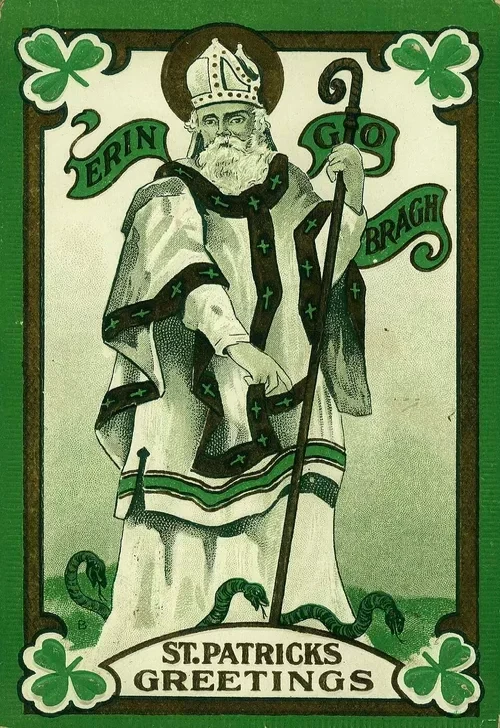
Saint Patrick was not Irish but born in Roman Britain (likely modern-day Scotland or Wales) around 373 CE into a Christian family. At age 16, he was kidnapped by Irish raiders and sold into slavery, forced to tend sheep in remote parts of Ireland for six years. During this time, he turned to prayer for comfort, developing a deep spiritual life. He later recounted hearing a divine voice telling him to escape, which he did, walking over 200 miles to the coast to find a ship back to Britain.
After returning home, he studied for the priesthood and eventually felt called back to Ireland—not as a conqueror, but as a missionary to the people who once enslaved him. He returned to Ireland around 433 CE, preaching Christianity, abolishing slavery and human sacrifice, and establishing churches. His mission was rooted in love and forgiveness, not conquest. He is said to have baptized thousands and trained leaders, even as he faced hostility from Druids and skepticism from some within the Church.
One of the most powerful aspects of his story is his transformation from a young man with a nominal faith to a man whose life was defined by prayer, resilience, and grace. He famously described himself as “a sinner, a simple country person, and the least of all believers” in his own writings—the Confessio. His legacy is not in mythical tales of driving snakes from Ireland or using a shamrock to explain the Trinity, but in a life of redemption, courage, and unwavering faith.
His “Breastplate of Saint Patrick” prayer—“Christ with me, Christ before me, Christ behind me…”—remains a powerful spiritual tool today. It reflects his deep trust in God’s presence through suffering and mission. The true story of Saint Patrick is one of forgiveness, purpose, and the power of a transformed life—a timeless inspiration for anyone facing hardship or seeking to make a difference.
God with Us (In the Game) pt.3
All Scripture reference taken from the New Living Translation
Here we are in part three of our God with Us series…
We started this series a few weeks ago looking at some basic theology that helps connects the dots to our faith in a way the hopefully would make conversation engaging with those who are interested in Christianity…
Two weeks ago, we looked at the central theme to our faith… The theme that is woven all throughout the Bible… The topic Jesus taught on the most…
And that is the Kingdom of God… The Kingdom of Heaven…
We looked at some different perspectives that build on each other from three different people in the Bible…
The Kingdom of God is a supernatural realm of divine rule that is over all things…
The Kingdom of God is unique… It’s a Kingdom without borders and it supersedes all cultures, races, and classes…
There are no exclusions in the Kingdom of Heaven… All are welcome!
It is a Kingdom we are called to be a part of and participate in as we are all called by God to join Him in reconciling others back to Him through Jesus…
So, how do we do this… How do we even participate in the Kingdom… How do we join God in what He is doing around us?
Before we get into the, “What does it look like?” part of participation…
Let’s talk about what we are supposed to look like… What do Kingdom people look like?
This is an important question to ask, because the answer to this question comes before the answer to the, what does Kingdom participation look like?
Let’s use sports teams as an analogy…
It’s very similar to being on a sports team… Uniforms identify teams… There is an outward appearance used as an identifying marker for each team…
What identifies another believer? How do Christians make a distinction between Godly and worldly people?
If we are all in this Kingdom life together… If we are all in the game of reconciling others back to God through Jesus… Then how do we identify each other… How do we recognize each other out on the playing field?
And better yet… How does someone identify us as a follower of Jesus?
How does our outward appearance… Or outward actions… Set us apart from the world…
How does the light of Jesus shine through us in a way the puts us in the game of life we call Kingdom living?
There is a common theme that runs through the entire New Testament the Apostle Paul, Peter, and even the writer of Hebrews teaches when it comes to the appearance of a follower of Jesus…
This common theme tells what we are to clothe ourselves with…
This common theme are the characteristics that make up the identifying markers of a Christian.
Colossians 3:12-15 – 12 Since God chose you to be the holy people he loves, you must clothe yourselves with tenderhearted mercy, kindness, humility, gentleness, and patience. 13 Make allowance for each other’s faults, and forgive anyone who offends you. Remember, the Lord forgave you, so you must forgive others. 14 Above all, clothe yourselves with love, which binds us all together in perfect harmony. 15 And let the peace that comes from Christ rule in your hearts. For as members of one body you are called to live in peace. And always be thankful.
This is just a short passage of an entire chapter that teaches us how we are to live as followers of Jesus… As those who represent Jesus and all that He stands for!
v.12 – Since God chose you to be the holy people He loves…
Let’s unpack this one sentence for a minute…
This falls under the message of reconciliation… Each one of us have been chosen by God to be a person He loves!
Does that mean He didn’t love us before we put our faith in Him? Absolutely not!
What it does mean is that we were once living apart from Him… We were living under His judgment… There is no in between… We are either living for God or apart from God…
We either accept Jesus and what He did on the Cross for us or reject Him!
Because of sin that entered the world (We talked about this in part one of this series) all of mankind has been separated from God… We are born with a sinful nature…
Ever since the fall of mankind, God has been constantly calling people, all people, into a relationship with Him… And this can only happen through Jesus…
The moment we put our faith in Jesus, the relationship between us and our Creator has been restored… We have now become a chosen and holy person…
When it comes to the word, “holy” and connecting that to how we see ourselves, a lot of people often feel inadequate with making this connection…
It’s a word that holds some weight and we often do not feel worthy of that title in connection to how we see ourselves…
When we look at ourselves in the mirror we see our imperfections, our flaws, our shortcomings… But God sees us as perfect… And holy…
Simply put, holy means that God has set us apart… We are set apart… We are set apart from the world… We are to be distinct and unique…
And part of our identity in Christ is that we are holy and dearly loved by God!
There is nothing we can do to earn God’s love or to earn the status of being set apart…
God chose us… He picked us to be on His team… We are a chosen people and now belong to the Kingdom of Heaven…
Part of our identity in Jesus that comes with our salvation is that we are citizens of Heaven… Which means we are a people who eagerly wait for the return of Jesus…
But in the meantime, we are also His ambassadors… We represent the Kingdom of Heaven in such a way that we are to make the lifestyle of Christianity appealing to those who have yet to taste and see how good the joy of the Lord is…
Therefore, we must cloth ourselves with tenderhearted mercies, kindness, humility, gentleness, patience, forgive those who offend us, love unconditionally, live in harmony with others…
And let the peace of Christ rule our hearts as a thankful attitude guides us through each day…
This isn’t always easy, but it is an expectation for the price Jesus paid for us on the Cross…
And so, it is important to note that each one of the virtues…
Each of these characteristics found in the personality of a follower of Jesus are characteristics that express themselves in relationships…
As they reflect our relationship with Jesus…
This passage in Colossians is a theme that can be found all throughout the teachings of the New Testament as to how we are to relate to others….
And these character traits are what we can use as identifying markers of a Christian
You see, the greatest Christian virtues are those which govern human relationships.
What we are talking about are virtues that build relationships… Build bridges, and tear down walls between people and even people groups…
These are traits that play a role in reconciling others back to God through Jesus!
These are traits that start with a heart of compassion… A heart that Jesus Himself gives us that is in response to the mercies of God…
A heart of compassion is in response to being reconciled back to God through Jesus…
And is now filled with love and concern for others instead of someone who only looks out for themselves…
Matthew 5:8 – God blesses those whose hearts are pure, for they will see God.
It’s no mistake that the first virtue we see in Colossians is tenderhearted mercies…
Tenderhearted mercy in the Greek refers to a deep, heartfelt awareness of and sympathy for those suffering and in need…
As part of God’s character, we see a deep sense of compassion as a central theme to His love for mankind… And Jesus came to reveal this in person…
As Kingdom people we cannot just stand back from the hurting or observe from a distance…
Kingdom people lean in and hurt with the hurting… They show up and care for those in need…
Because that’s what God does… Mercy reflects the heart of God…
God is not distant and He hears the cries of those suffering…
Exodus 3:9 – Look! The cry of the people of Israel has reached Me, and I have seen how harshly the Egyptians abuse them.
Prior to this verse God is telling Moses that He is aware of the Israelites suffering, and that He is coming down to rescue them…
What this tells us is that God is a God who is involved in our lives… Even when He seems distant, His mercies are new each day…
Lamentations 3:22-23 – The faithful love of the Lord never ends! His mercies never cease. Great is His faithfulness; His mercies begin afresh each morning.
Psalm 145:9 – The Lord is good to everyone. He showers compassion on all His creation.
God is involved and He moves toward us when we are hurting… He does not look the other way…
We see this same heart in Jesus… He modeled this very virtue when He walked the earth…
When He saw the pain in others… He moved toward them in compassion…
His tenderhearted mercies that are afresh each morning moved Him to spend time with those who were being mistreated and misled… Often by the very religious system that was to extend compassion…
Matthew 9:36 – When He saw the crowds, He had compassion on them because they were confused and helpless, like sheep without a shepherd.
It was compassion for mankind that motivated Jesus to endure the Cross on our behalf…
Church, if we are going to find our identity in Jesus… It starts with a heart of mercy and compassion for others…
Moving toward those who are hurting and walking beside them in their pain…
And it is a result of the mercy and compassion we ourselves receive from Jesus!
Before we bring the message to a close, I want to touch on verse 13 for a minute…
Colossians 3:13 – Make allowance for each other’s faults, and forgive anyone who offends you. Remember, the Lord forgave you, so you must forgive others.
This is how we create an atmosphere of harmony by loving others regardless of what they do, the way they might go about handling certain situations, or the ideologies they believe in…
And I believe there is a certain amount of discernment that comes with this…
But as we are all doing life together… It’s important that we treat others with kindness and grace…
And we do this with the effort to bring harmony into the environment we find ourselves in…
Bearing with one another as we make an allowance for mistakes people make… Unintentional offences… Or even things people do that we might do differently…
Forgiveness is huge… Holding grudges or not forgiving someone is a big deal…
And I want to preface this with… I understand some things take time to forgive…
There are times that before forgiveness can be extended, there may need to be some time to heal and process the magnitude of what we are dealing with…
As Christians, extending forgiveness is not an option according to Jesus…
Matthew 6:14-15 – If you forgive those who sin against you, your heavenly Father will forgive you. But if you refuse to forgive others, your Father will not forgive your sins.
We must be able to forgive others in the same manner Jesus forgives us!
When we think about all that Jesus has forgiven us for… It should create within us generous heart for forgiveness…
God forgives knowing we are going to sin again… And often in the same manner He just forgave us for…
God reaches out with a heart of forgiveness before we even come to Him seeking forgiveness…
God’s forgiveness offers complete restoration and honor… It restores our dignity and brings us into an atmosphere of spiritual freedom…
No longer being held by the bondage of sin… Forgiveness brings healing!!!
God’s forgiveness restores the relationship of mankind and its Creator…
God’s forgiveness completes the process of reconciliation… Often over and over again…
These are just a few reasons why it is important we also learn how to forgive…
Forgiveness not only restores our relationship with Jesus… But it often restores our relationship with ourselves and others…
We cloth ourselves with tender mercies when we let go of grudges, hurts, and resentments by extending grace and forgiveness to those who have wronged us…
In Closing…
As followers of Jesus… As people who have experienced the goodness of God…
The tenderhearted mercies that are afresh each day…
The forgiveness and unconditional love of a God who cares for His creation.
Our response is to extend the same to those around us…
This is how we represent Jesus… This is how we represent the Kingdom of God…
This is the greatest way we can serve God and serve people in the hopes of reconciling others back to God through Jesus…
It’s also how we can recognize fellow believers amongst us…
I’ll leave you with this passage today…
Romans 12:14-18 – Bless those who persecute you. Don’t curse them; pray that God will bless them. Be happy with those who are happy, and weep with those who weep. Live in harmony with each other. Don’t be too proud to enjoy the company of ordinary people. And don’t think you know it all! Never pay back evil with more evil. Do things in such a way that everyone can see you are honorable. Do all that you can to live in peace with everyone.
Amen!
Marked for Life
by Dr.H.D. King
New Castle Correctional Facility, Indiana
For those incarcerated it is no secret that our past conduct and the criminal system
will forever follow us. Our blemishes and records have a way of speaking about us and against us. While it is true that it is prior conduct, or ought to be, it is a reflection of
choices we have previously made. So what exactly does it mean to be marked for life?
The Merriam Webster Dictionary defines “marked” as: 1) it having an identifying mark; 2) having a distinctive or emphasized character; and, 3) being an object of attack, suspicion, or vengeance. These definitions are not far from the biblical use of the word as well.
As I write this piece, I consider the first usage of the word in the book of Genesis,
“And the Lord set a mark upon Cain, Lest any finding him should kill hm.” (Genesis 4:15) We understand that, in context, Cain slew Abel, his brother, and his conscience spoke against him. Cain feared for his life. We could say that he was a “marked man”.
And indeed , he was in more ways than one. Yet, the Lord chose to identify Cain as being the object of his mercy. We should understand this passage in the sense of a sign
given to assure that God’s promise to protect Cain would be fulfilled. How does this relate to you and me today?
As believers in Christ, we identify with Him through saving faith and obedience to the command to be baptized (Romans 6:4). We are then sealed by the Holy Spirit and marked as belonging to Christ according to 2 Corinthians 1:22. Because of this, our lives ought to be a sign to the world around us of Whom we belong to and serve. Consider the words from Psalm 37:37: “Mark the perfect man, and behold the upright: for the end
of that man is peace.” In a similar fashion the Apostle Paul writes to the Romans. “Now I beseech you, brethren, mark them which causes divisions and offenses contrary to the doctrine which ye have learned; and avoid them.” (Romans 16:17)
Therefore the usage of the word “mark” has both negative and positive connotations. Is it a coincidence that in Revelation 13:17 the Antichrist will seek to gain economic control of the world through the use of a mark? Those who accept it (the mark of the beast) will identify with him and the world system. Equally true is the fact that the hundred and forty-four thousand have the Father’s name written on their foreheads. (Revelation 14:1) Both groups are marked for life!
In closing, the Apostle Paul exhorts the Thessalonians with these words: “And we
beseech you, brethren, to know (mark) them which labor among you, and are over you in the Lord, and admonish you; and to esteem them very highly in love for their work’s sake…” (Thessalonians 5:12-13) We have eliminated the issue of whether a man is marked. The question which remains is, “How will you be marked?” Whatever you accept—remember, you are “Marked for Life”. In His Love, Dr. H.D. King
St. Patrick’s Day Jokes
- Why did St. Patrick drive the snakes out of Ireland?
Because he couldn’t afford a plane ticket. - Why shouldn’t you iron a four-leaf clover?
You might press your luck! - How did the Irish jig get started?
Too much water to drink and not enough restrooms. - How do musicians show off on St. Paddy’s Day?
They play their brag-pipes. - What would St. Patrick order to drink at a restaurant?
Green tea. - Do people get jealous of the Irish?
Yes, they’re green with envy! - What are the best shoes to wear on St. Patrick’s Day?
Lepre-converse. - What is a huge Irish spider called?
Paddy Long Legs. - How can you tell when a potato is not from Ireland?
When it’s a French fry. - Why do Irish people recycle?
They like to go green! - What’s an Irish baby’s favorite song?
“Paddy Cake.” - What did the Irishman say to his lass after she broke up with him?
“I’m already clover it!” - What do you get if you cross Christmas with St. Patrick’s Day?
St. O’Claus! - Why did the baker pour Coke into her mixer?
She was trying to make Irish soda bread! - What’s the perfect St. Paddy’s Day breakfast?
Green eggs and ham. - What’s Irish and stays out all night?
Paddy-o furniture. - When does Valentine’s Day come after St. Patrick’s Day?
In the dictionary. - What do you call an Irishman who finds a pot of gold?
Lucky! - How did the Irish musician fix his instrument?
He just fiddled with it a bit. - Why are Irishmen so passionate about sustainability?
They’re committed to green living. - What’s an Irish child’s favorite toy?
A Cabbage Patch Kid. - What’s the Irish’s favorite part of Fenway Park?
The Green Monster. - Who is St. Patrick’s favorite superhero?
The Green Lantern. - What did the Irish potato say to his sweetheart?
“I only have eyes for you.” - Why do frogs love St. Patrick’s Day?
They’re always wearing green. - Why does the River Shannon have so much money in it?
Because it has two banks. - What did the Irish referee say at the end of the soccer match?
“Game clover.” - What do you call an Irishman who’s bouncing off the walls?
Rick O’Shay. - What’s green and sings?
Elvis Parsley. - What’s big and purple and lies next to Ireland?
Grape Britain. - What kind of bow can’t be tied?
A rainbow. - What does Ireland have more of than any other country?
Irishmen.